
IVF and ICSI Success Rates by Age: What the Numbers Mean
Center : Nakornthon Gift Fertility Center
Article by : Dr. Ong-Arj Bovornsakulvong

- Age is the single biggest factor in fertility treatment outcomes when using your own eggs, because both the number and quality of eggs naturally decline over time.
- The age that matters most is when your eggs are collected, not when they are transferred, which is why freezing eggs at a younger age can lead to stronger results later in life.
- ICSI is designed for male factor infertility and helps overcome fertilization barriers, but it does not change the age of your eggs or override age-related decline in egg quality.
- The two-week wait between embryo transfer and pregnancy testing is widely described as the most emotionally challenging stage of treatment, even more than the daily injections during stimulation.
- Lab quality, embryo monitoring, and genetic screening of embryos before transfer can meaningfully improve your outcome, especially for patients over 35 where chromosomal abnormalities in eggs become more common.
“What are our chances?” Almost every couple’s first question to a fertility specialist is this, and it’s the toughest to answer with a single number. Your chances depend on your age, health, the reason for infertility, and your treatment location.
The IVF success rate by age shifts dramatically from your early 30s to your early 40s, and the ICSI success rate tells a different story depending on the cause. Knowing how these numbers work puts you back in the driver's seat.
Table of Contents
- Why Age Matters More Than Anything Else
- IVF Success Rate by Age, Made Simple
- How ICSI Success Rate Compares to Standard IVF
- The IVF Journey: What Each Stage Feels Like
- What Else Affects Your Chances
- Why Patients Choose Nakornthon Gift Fertility Cente
- When Should You See a Fertility Specialist?
- Frequently Asked Questions About IVF and ICSI Success Rate by Age
- Free Online Consultation with a Specialist
Why Age Matters More Than Anything Else
You are born with all the eggs you will ever have. Over time, the number drops, and so does the quality. Younger eggs fertilize more easily and develop into healthier embryos. Sperm quality also changes with age, though the decline tends to come later, which is one reason ICSI is often recommended when male factor infertility is involved, or for women of advanced maternal age who are 35 and older.
Patients often overlook a crucial detail: the age that counts is your egg-retrieval age, not your egg-transfer age. This is why younger, frozen eggs are more effective than fresh eggs from an older age.
IVF Success Rate by Age, Made Simple
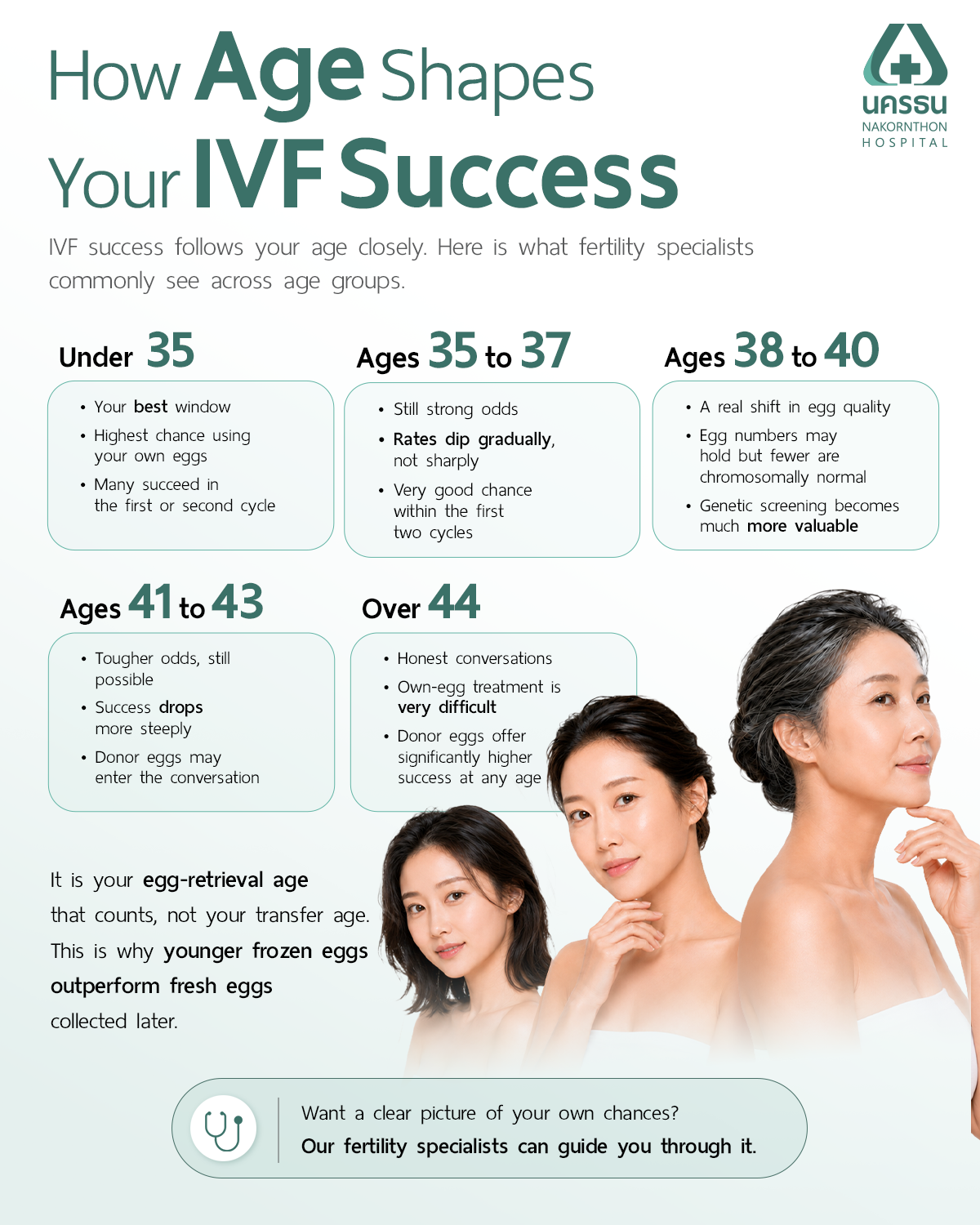
Here is what fertility specialists commonly observe across age groups:
Under 35: Your Best Window
Fertility treatment success is greatest for this age group; women here utilizing their own eggs typically have very favorable prospects after egg retrieval, with numerous pregnancies occurring in the first or second attempt.
Ages 35 to 37: Still Strong
Success rates start to dip a little, but the change is gradual. Most women in this group still have a very good chance, especially within the first two cycles. Your specialist may recommend slightly more medication during stimulation.
Ages 38 to 40: A Real Shift
The primary difficulty lies in egg quality; while egg production may remain consistent, the number of chromosomally sound eggs will decrease. Genetic screening becomes much more valuable, and patients in this group often need more than one cycle to find the right embryo to transfer.
Ages 41 to 43: Tougher Odds, Still Possible
Success rates drop more steeply. Many patients still pursue treatment with their own eggs, and some succeed. Your specialist may also discuss donor eggs if previous cycles have not worked out.
Over 44: Honest Conversations
Treatment using your own eggs becomes very difficult. Donor eggs are often the recommended path, since they offer significantly higher success rates regardless of age.

How ICSI Success Rate Compares to Standard IVF
In standard IVF, eggs and sperm are placed together in a dish, and fertilization happens on its own. With ICSI, the embryologist injects a single healthy sperm directly into a mature egg, giving nature a guided assist. It is especially helpful when:
- The male partner has low sperm count, poor motility, or unusual sperm shape
- The previous standard treatment had poor fertilization
- Sperm needs to be retrieved surgically
- Frozen eggs are being used, which have harder shells
- Embryos will be tested genetically before transfer
One important point: ICSI helps you past fertilization barriers, but it does not change egg age. It is a powerful tool, not a workaround for biology.
At Nakornthon Gift Fertility Center, we report a 71% success rate from cycles that combine ICSI with Next Generation Sequencing genetic screening, where only chromosomally healthy embryos are selected for transfer. This sits above typical global ICSI averages because the screening removes embryos unlikely to succeed.
The IVF Journey: What Each Stage Feels Like
Stimulation: Daily Injections for About Two Weeks
You will give yourself hormone injections daily for around 10 to 14 days, with regular check-ins over 3 to 4 visits as your specialist tracks how your ovaries respond. Bloating, mood swings, and abdominal heaviness are common.
Egg Collection: A Short Procedure
This is a brief procedure done under sedation, and most patients recover quickly. The embryologist will then tell you how many eggs were collected and how many were mature, as only mature eggs are suitable for ICSI.
Embryo Development: Watching the Numbers
Over the next few days, the count drops from eggs collected, to fertilized eggs, to Day 3 embryos, to Day 5 or Day 6 blastocysts. Some attrition at every stage is normal. Continuous monitoring through tools like EmbryoScope Plus at our center allows our team to track development without disturbing the embryos. The strongest embryos are then selected for transfer to the uterus. Any remaining embryos are frozen for future cycles, especially when no chromosomal testing has been done.
The Two-Week Wait: The Hardest Part for Most Patients
After transfer, you wait roughly two weeks for a reliable pregnancy test result. Most patients describe this as the most emotionally difficult stage. Be kind to yourself during this time.
Results: Whatever Happens, You Are Not Alone
A negative result after a full cycle is hard, and we acknowledge that openly. It is also not the end of the road, as many patients who succeed do so on their second or third cycle.

What Else Affects Your Chances
- Sperm health. A standard semen analysis only tells part of the story. Sperm DNA quality testing can reveal issues that motility and count miss.
- Uterine health. Even a high-quality embryo needs a receptive uterus. Fibroids, polyps, or a thin endometrial lining can affect implantation.
- Lifestyle. Body weight at either extreme can affect ovarian response, and smoking is a clear negative. Stopping before treatment makes a real difference.
- Stress and sleep. The months leading up to treatment are easier with steady sleep, gentle movement, and a strong support system.
Why Patients Choose Nakornthon Gift Fertility Cente
For international patients considering IVF and ICSI in Thailand, our 71% ICSI-NGS success rate reflects advanced genetic screening, modern lab technology, and experienced specialists.
For over 17 years, Nakornthon Hospital's Fertility Center has been caring for patients, and now operates in partnership with Gift Fertility Co., Ltd. to deepen that expertise further. Our specialists each bring more than 20 years of experience, working with a laboratory equipped with EmbryoScope Plus, AI-assisted semen analysis, and the full range of genetic screening options performed in-house. Alongside this, treatment in Thailand is significantly more affordable than equivalent care in the United States, the United Kingdom, or Australia, and we offer free online consultations before you travel.
When Should You See a Fertility Specialist?
For those under 35 who have been trying to conceive for one year, a consultation is recommended. For those aged 35 and above, this period decreases to approximately six months. There’s no need to delay if you already have known factors like irregular cycles, a prior diagnosis, or male-factor issues.
Your family story is worth a real conversation. Make an appointment and find a fertility specialist at Nakornthon Hospital today.
Free Online Consultation
- Facebook Fanpage: Nakornthon Hospital - International Patient
- LINE Official: @nakornthoninter
- Tel: 02-450-9999 1159-1160
Frequently Asked Questions About IVF and ICSI Success Rate by Age
-
Q: At what age is IVF most successful?
A: Treatment is most successful for women under 35 using their own eggs, where chances after a successful egg collection are at their highest. Outcomes start to dip from age 35 and drop more steeply after 40 due to natural changes in egg quality.
-
Q: Which stage of IVF is most difficult?
A: Most patients say the two-week wait between embryo transfer and pregnancy testing is the hardest part emotionally. Physically, the daily injections during stimulation are demanding, but the not-knowing during the two-week wait is what patients remember most.
-
Q: Is the ICSI success rate higher than standard IVF?
A: ICSI achieves higher fertilization rates when male factor infertility is involved, which is what it was originally designed for. For couples without male factor issues, fertilization and live birth rates are generally similar between the two methods. Once an embryo is created, the chances of pregnancy depend mostly on egg quality and embryo health, which are not affected by the fertilization technique used.
-
Q: Why is Nakornthon's success rate higher than the global average?
A: Our 71% rate is from cycles that combine ICSI with NGS genetic screening, where only chromosomally healthy embryos are chosen for transfer. This selection step alone significantly improves outcomes. Combined with EmbryoScope Plus monitoring and specialists with over 20 years of experience, our patients benefit from a treatment approach designed to maximize their chances at every step.
Free Online Consultation

Article of Nakornthon Gift Fertility Center


Infertility: A Common Reproductive Issue That Can Prevent Pregnancy



Embryo Chromosome Screening Using NGS: A Technique for Detecting Fetal Abnormalities Before Pregnancy